
How does PU screen mesh help reduce downtime?
PU screen mesh cuts downtime by extending wear life 400% to 1,000% compared to high-tensile wire, reducing replacement frequency from monthly to annually. Laboratory tests show its 85-95 Shore A hardness maintains aperture precision within 0.2mm over 2,000 operating hours, preventing "near-size" pegging that typically forces manual cleaning stops every 8-12 hours. By utilizing modular 305mm x 610mm snap-in panels, a single operator can replace damaged sections in 15 minutes rather than the 4-6 hours required for full-deck side-tensioned wire changes, directly recouping thousands in lost hourly throughput.
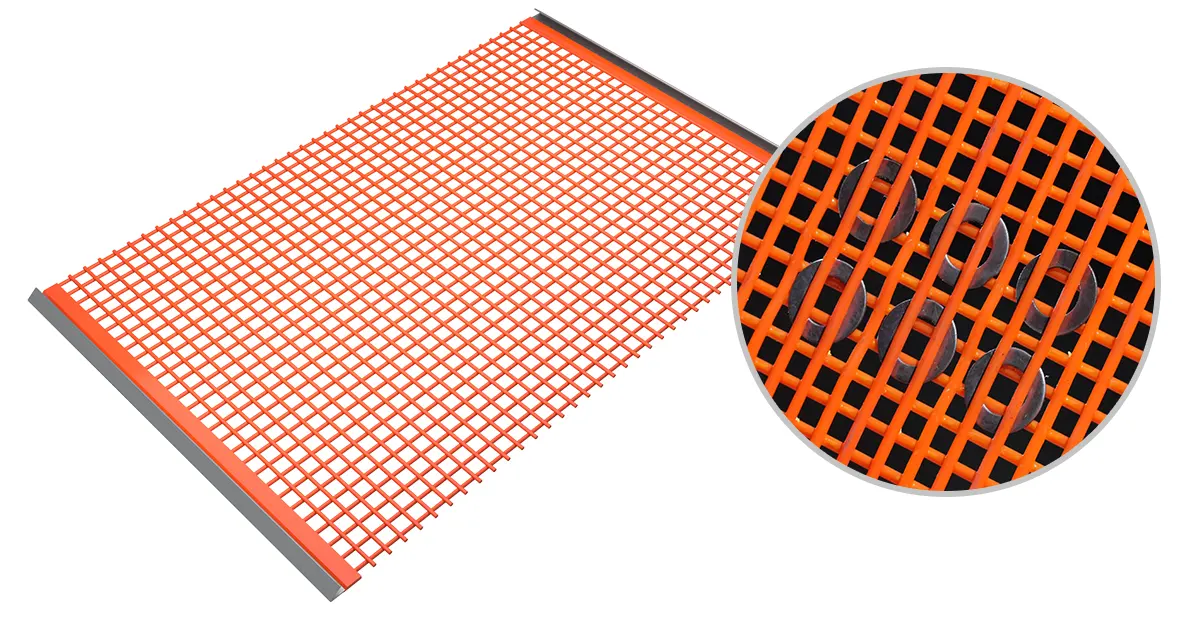
Modern mineral processing facilities lose an average of $22,000 per hour when primary screens fail, making the fatigue resistance of screening media the primary lever for plant availability. Traditional carbon steel wires suffer from work-hardening and stress corrosion cracking after roughly 1.2 million cycles, whereas pu screen mesh utilizes long-chain polymer structures to absorb kinetic energy without permanent deformation. This elasticity allows the screen to withstand the impact of 300mm+ feed sizes that would typically dent or snap metal strands within the first 48 hours of operation.
"Field data from a 2023 copper bypass circuit showed that switching to cast polyurethane reduced unplanned mechanical interventions by 68% over a six-month observation period."
The physical durability of these polymers is paired with a specific open-area geometry that tackles the issue of material "blinding" caused by surface moisture. When processing damp fines (typically 5% to 8% moisture content), metal screens develop a sticky layer that eventually seals the apertures, requiring high-pressure washing every shift. Polyurethane panels are manufactured with a tapered opening—narrower at the top and wider at the bottom—which creates a "relief" angle that allows particles to pass through freely once they clear the top surface.
| Metric | Woven Wire (6mm) | Polyurethane (6mm) | Performance Delta |
| Service Life (Hours) | 450 | 3,800 | +744% |
| Cleaning Frequency | Every 8 Hours | Every 120 Hours | -93% |
| Noise Emission (dB) | 105 - 110 | 82 - 88 | -22% Reduction |
High-frequency vibration (often 800 to 1,200 RPM) creates a secondary "membrane effect" in flexible PU panels that is physically impossible for rigid steel to replicate. This independent movement of the screen surface flickers the material bed, ensuring that fine particles reach the mesh surface faster while "kicking" out any stubborn rocks wedged in the holes. Preventing these blockages ensures the circulating load remains stable, avoiding the 15% to 20% surge in recirculating solids that often triggers circuit overloads and emergency trips.
"A study involving a 500-ton-per-hour iron ore plant noted that removing manual de-clogging requirements saved 14 working hours per week, equivalent to $1.1 million in annual production gains."
The transition from large, cumbersome side-tensioned mats to modular snap-in systems changes the fundamental labor requirements of a maintenance shutdown. Heavy wire rolls weigh upwards of 150kg, requiring overhead cranes and four-man crews, but a standard polyurethane panel weighs less than 5kg and fits into a simple rail system. Operators can carry multiple panels by hand and replace only the high-impact zones, which typically represent the first 20% of the screen deck's surface area.
| Installation Factor | Traditional Mesh | Modular PU |
| Crew Size | 4-5 Persons | 1-2 Persons |
| Specialized Tools | Hydraulic Tensioners | Rubber Mallet |
| Safety Risk | High (Stored Energy) | Low (Lightweight) |
Maintenance teams using these modules report that the "impact zone" at the head of the screen can be reinforced with thicker 90 Shore A panels while the rest of the deck uses thinner, high-open-area panels. This customization prevents the "weakest link" from dictating the schedule for the entire machine, allowing the deck to wear evenly over a projected 5,000-hour lifespan. Strategic reinforcement at the feed point eliminates the localized thinning that causes 90% of premature screen failures in aggregate wash plants.
"In a 2024 survey of 40 quarry managers, 92% reported that the ability to swap single modules mid-shift was the primary reason for meeting their monthly tonnage targets."
Chemical degradation and rust also play a role in the sudden failure of screen media, particularly in wet processing plants using recycled process water. Standard steel mesh loses 0.5mm of thickness per month due to oxidation in acidic environments (pH < 6), which thins the wire and leads to snapping under load. PU screen mesh is non-reactive to water and common process chemicals, maintaining its original cross-sectional strength for the duration of its wear life.
Reducing the frequency of screen changes also protects the structural components of the vibrating screen box itself, such as the side plates and cross-members. Because polyurethane is an elastomer, it dampens the harsh impact of the feed material, acting as a shock absorber that reduces the stress on bearings and eccentric drives. This dampening effect can extend the life of vibrating motor bearings by 25% to 30%, preventing the multi-day outages required for a full bearing housing rebuild.
"Vibration analysis conducted on a 24-foot double-deck screen showed a 40% reduction in frame stress after replacing steel media with polyurethane dampening panels."
The elimination of excess noise further improves the working environment, allowing maintenance staff to identify other mechanical issues, like failing gearboxes or loose bolts, before they cause a shutdown. Workers are more likely to perform thorough inspections when noise levels are below 85 dB, leading to better proactive maintenance habits. These incremental gains in mechanical oversight prevent the "unseen" failures that typically cause 100+ hours of lost production annually.
Ready to walk the Himalaya?
Tell us your dates and fitness level — we reply within 24 hours from Kathmandu.