
A Scent Museum Visit as a Buyer's Checklist for a Seasonal Fragrance Line
A visit to a specialist scent museum is one of the most information-dense hours a fragrance buyer can spend before committing to a seasonal line. A museum built by a manufacturer shows how that house thinks about materials, stability and presentation, which is exactly the evidence a seasonal brief needs. Put the visit on the calendar before the development brief goes out, not after the samples come back.
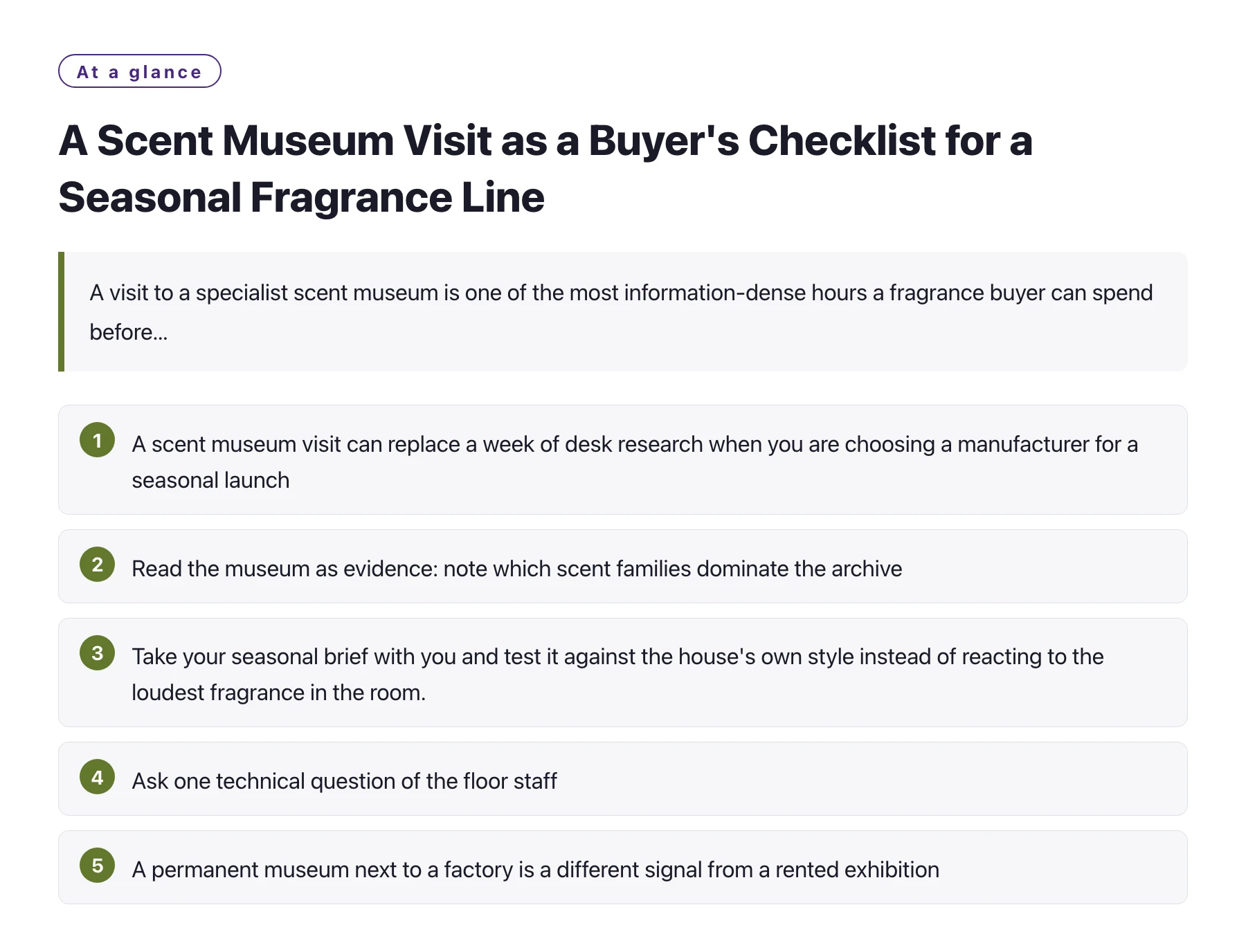
Key takeawaysA scent museum visit can replace a week of desk research when you are choosing a manufacturer for a seasonal launch, because it shows the house's material taste and production depth in a single afternoon. · Read the museum as evidence: note which scent families dominate the archive, how older exhibits are refreshed, and whether the experience is built for education or for sales. · Take your seasonal brief with you and test it against the house's own style instead of reacting to the loudest fragrance in the room. · Ask one technical question of the floor staff, about stability or material availability, and judge the quality of the answer rather than the scent. · A permanent museum next to a factory is a different signal from a rented exhibition, and the distinction is worth checking on the ground.
Museum visits sound like a luxury step in a supply chain that runs on samples, quotes and shipping dates. In practice they are one of the fastest ways to learn how a fragrance house actually works, because a good museum is a curated argument: these are the materials we treat as signature, this is how we build a story from a single note, this is how far we take presentation.
For a seasonal collection, where the calendar is short and the brief is often still vague, that argument is directly usable. This article is a checklist for turning a museum visit into supplier evidence rather than a pleasant afternoon.
Why a scent museum belongs in your shortlist
A fragrance museum is not a shop with better lighting. It is a long-term statement about a particular house: which materials it treats as signature, how it builds accords, and how much engineering goes into packaging and presentation. For a buyer, that statement is readable information, and it is the same material the house's perfumers work from.
A manufacturer that keeps a permanent scent museum alongside production, such as the Guangzhou scent museum run by the Guangzhou fragrance house Xuelei, is effectively displaying its reference library. You can read it in an afternoon; digging the same insight out of brochures takes weeks of calls.
The International Council of Museums defines a museum as a permanent, non-profit institution in the service of society, a bar most factory showrooms do not claim — and knowing which of the two you are standing in tells you whether the visit is evidence or marketing [1].
What to look for before you book the trip
Read the collection in the order it was built
Perfume is conventionally described as unfolding through top, heart and base notes, and that framework is also a useful way to pace a museum visit [2]. Start with the oldest or most foundational exhibits and work forward; the sequence shows how the house's taste changed, which is more informative than its current hero product.
Watch how the scents are staged
Notice the mechanics: are the fragrances on open testers, on paper strips, in scent stations with forced air? How long does the house expect material to stay on skin or paper before it is judged? Staging decisions reveal how seriously the house takes evaluation, and evaluation discipline is what your sample rounds will depend on.
Check the museum's connection to production
If the museum sits in the same building as the compounding and filling lines, ask who built the archive and whether the development lab still uses it. A collection maintained by the factory's own perfumers is production evidence; a travelling exhibition tells you nothing about the factory behind it.
The visit checklist
| Check | What it signals | How to verify |
|---|---|---|
| Is the museum permanent | A long-term commitment to scent, not a pop-up | Ask how long the collection has been open and who curates it |
| Which families dominate the archive | The house's material strengths and signature range | Count the display families: floral, woody, fresh, gourmand |
| How older exhibits are kept current | Stability and ageing discipline | Ask staff how materials are replaced or refreshed |
| Whether bottles tell a design story | Packaging and decoration capability | Compare bottle shapes and decoration across eras |
| How well the floor staff can answer | Training level and technical depth | Ask one stability or material question and judge the answer |
Apply the same row of questions to every candidate you visit. A checklist only works when it is run against all of them, not just the ones with museums.
The single most useful question in any scent museum is the negative one: which of these fragrances would you not put into a seasonal collection, and why? A house that answers with a technical reason, such as stability or raw-material availability, understands seasonality as a production problem. A house that answers with marketing has told you everything you need to know.
Turning the visit into a seasonal decision
Seasonal collections compress the whole chain: development, stability, packaging, import paperwork. The museum visit sorts a house's strengths before those deadlines exist, which is the difference between choosing a partner and reacting to one.
Once the visit is over, check the paperwork against it. When the manufacturer's own pages describe the same capability — a fragrance house with both a museum and documented project material — the two corroborate each other. Ask for examples of fragrance projects that look like your seasonal brief and compare them with what you saw on the floor.
Reading the company behind the factory before you travel saves the first hour of the visit for the questions that actually matter, and it gives you a concrete baseline when the guide's story and the printed history diverge.
Sources
- ICOM — International Council of Museums —— The international organisation representing museums; publishes the ICOM museum definition and professional standards for museum practice.
- Wikipedia: Perfume —— An encyclopaedic overview of perfume covering definitions, history, the note structure of a fragrance and concentration terminology (background reference only).
Frequently asked questions
Is a museum visit worth it before the first sample?
If the museum is production-linked, yes: it shows material taste, stability discipline and packaging depth in an afternoon, and it gives you specific questions for the later audit. If it is a rented exhibition, treat it as marketing and skip it.
What should I ask during a scent museum visit?
Ask the negative question — which fragrance would not survive a seasonal run, and why — plus a stability question and a question about how the archive is maintained. The technical answers are the signal you are buying.
How long should a museum visit take?
Two to three hours is enough if you go with your seasonal brief in hand and resist the hero products. Rushing it in under an hour usually means you only remember the loudest scents.
Can a museum visit replace a factory audit?
No. It replaces desk research and sharpens the audit. Compliance, batch records and hygiene still have to be verified on site; a museum tells you how a house thinks, not how it operates.
How do I use the visit for a seasonal collection specifically?
Take the seasonal brief with you, test the house's archive against those constraints, and ask which of its own scents would be ruled out. The answers become the first three lines of your development checklist.
Ready to walk the Himalaya?
Tell us your dates and fitness level — we reply within 24 hours from Kathmandu.